


Case Study LegalTech · 2024

AI contracts a lawyer will sign with confidence.

Legaliser generates and analyzes contracts with AI for legal professionals. Generating the text is straightforward. We built the validation layer that makes the output reliable enough to put a name on. It now operates as Agreements.AI.

Client
Legaliser (Agreements.AI)
Sector
LegalTech · AI contracts
Engagement
End-to-end product build
Timeline
2024
Platform
Web app · RAG · API
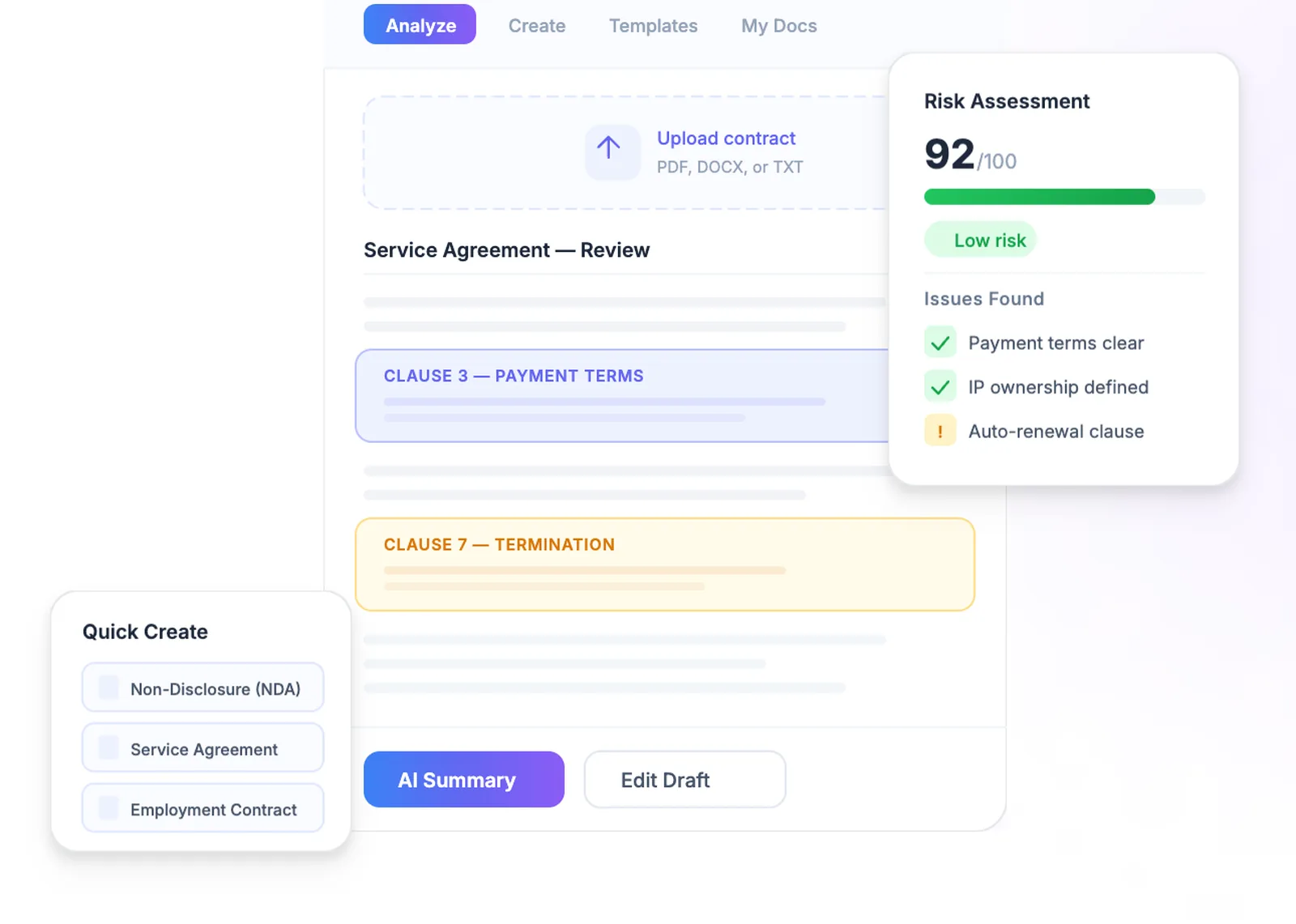
Legaliser contract workspace with an AI risk assessment scoring clauses for a service agreement
Plain English in, a scored, signable contract out.
By the numbers
~40%Faster contract production
350+Contract templates
0–100Clause risk score
3-layerValidation pipeline

Trust is what makes legal AI usable.

Any large language model can draft a contract that reads well. A polished contract can still hide a clause no one should sign, and in legal work that clause costs real money.

Legaliser set out to put contract drafting and review in the hands of people who aren't lawyers: founders, operators, lean legal teams, without lowering the bar on reliability. A hallucinated clause, a missed auto-renewal, an unbounded indemnity: one bad output costs more than the time the tool saved.

The brief went beyond generating contracts. Legaliser needed contracts a professional would put their name on, and getting there meant building a validation system around the model.

Retrieve the right law, then validate the output in layers.

We built the platform on a retrieval-augmented (RAG) architecture so every clause is grounded in real templates and precedent rather than the model's memory. The LLM pipeline drafts and analyzes; a layered validation system decides whether the result is trustworthy.

The validation runs in stages, each one cheaper to fail than the next, so the system catches problems before a reviewer sees them.

The validation pipeline

  • Schema checks: the contract has the right structure, parties, and required clauses
  • Semantic review: the model cross-checks meaning, risk, and missing protections
  • Human escalation: anything uncertain routes to a person rather than shipping silently
  • Plain-English summaries and a 0–100 risk score on each clause, so the reviewer knows what to look at first
Legaliser AI contract review with a risk assessment card scoring a service agreement 92 out of 100
What we built

Each clause scored before you sign.

Upload a contract and the platform returns a plain-English summary, a risk score, and the specific issues found across payment terms, IP ownership, and auto-renewal. The reviewer spends their time applying judgment instead of reading line by line.

0–100 risk score, clause by clause
In their words

Generating the text was straightforward. The work was making it reliable enough for a lawyer to put their name on it.

Legaliser AI contract platform · now Agreements.AI
More case studies →

Adoption that stuck in real legal workflows.

The validation-first approach made the product usable. Legaliser launched with hundreds of templates, AI analysis, and e-signature, and the team reports roughly 40% faster contract production for the people using it day to day.

Because the pipeline escalates uncertainty instead of hiding it, the tool earned trust in the workflows where a wrong answer is expensive: contract review, renewals, and indemnities.

The platform is live and continues to ship, now under the Agreements.AI brand, with SOC 2 infrastructure and a posture that keeps customer data out of model training.

Inside the product
Next.js TypeScript LangChain OpenAI RAG Elasticsearch Redis Fastify GCP Tailwind
Our role
Product, AI, engineering
Team
Lead build
Model
Delivered platform
Status
In production
Project partner Shahzaib

No tech team of your own? See how we work, compare in-house vs an agency, or read the build-without-a-tech-team guide.

Next / Your build

Taking on new builds

Have something in mind?

Tell us what you're making. We reply within a day with a fixed price and a date.