

Case Study HYSS

Book, schedule and pay your AV crew from one system.

HYSS gives AV and live-events companies one place to staff a show, catch a conflict before it lands, and pay everyone after. Freelancers keep a profile, share availability, and get paid. We built the platform architecture and backend, with a conflict engine that validates every booking and billing that stays private across shared jobs.

Client
HYSS
Sector
AV & live events · Crew ops
Engagement
Platform architecture & backend
Stage
Live
Platform
Web · iOS · Android
The HYSS dark homepage hero with the headline There's a better way to staff your events, above the crew booking product
One platform for the whole job: staff the show, catch conflicts, send the call sheet, invoice each client.
By the numbers
3Worker types in one model
Real-timeConflict detection
2-sidedEmployers + freelancers
iOS + AndroidNative apps

AV crew scheduling runs on spreadsheets, group texts and guesswork.

An AV company staffs a show by texting thirty-five freelancers for availability, then cross-referencing the replies against a spreadsheet by hand. The errors hide in that gap.

Two managers book the same engineer for the same Saturday, and nobody finds out until load-in. A client moves an event by a day, and a booking that looked solid quietly breaks. W-9 and COI documents sit in inboxes while someone chases who has sent what. Invoicing crawls across clients who each pay a different rate.

The call sheet is the part everyone feels. You build it, send it, then a detail changes and every copy in every inbox goes stale at once. The version on a phone at the venue is the version that matters, and it is the one most likely to be wrong.

Worker type belongs to the booking, not the person.

Zain built the platform architecture and backend on one idea that shapes the rest. The same person can work as an employee on Monday, a freelancer on Wednesday, and an agency hire on Friday. A worker-source tag on each assignment carries that context, so rates, overtime and cost bucketing resolve from the booking instead of from a fixed profile.

What that meant in practice

  • A worker-source tag on every assignment that resolves rates, overtime and cost bucketing on its own, and payment routing that keeps each employer's invoices isolated on shared jobs
  • Shadow profiles that let schedulers plan with unregistered crew, while hard rules block official assignment until that person creates an account
  • A conflict engine that validates availability before any booking is written and shows an impact diff before a mutation commits, expanding recurring schedules into discrete occurrence rows so recurrence is checked like any one-off
  • Load-weighted auto-assignment that spreads shifts evenly across the roster, guarded by a boundary-probing test suite over the pay and access rules
A freelancer public profile in HYSS showing positions, gear competencies and ratings
Freelancer profiles

Each freelancer carries one profile across every employer.

A freelancer keeps positions, gear competencies and ratings in one place. A scheduler filters the roster by who is free, qualified and nearby, then sends a structured offer the crew member confirms in a tap. The same profile follows that person whether they show up as a freelancer, an employee or an agency hire.

One profile · positions, gear, ratings
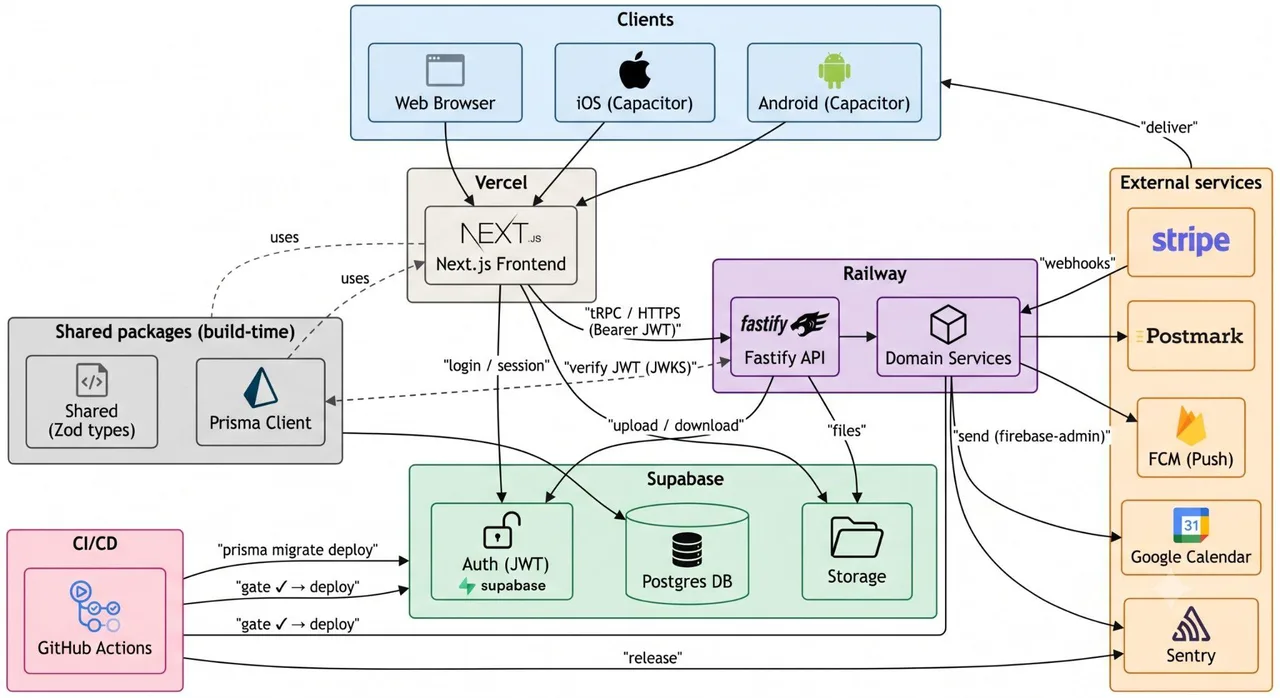
The HYSS system architecture diagram showing the booking model, conflict engine and payment routing
Architecture

The conflict engine runs before the write lands.

Before any booking is persisted, the system queries that worker's existing assignments and rejects any time overlap as a validation error. An edit triggers a pre-commit traversal of every affected booking and constraint, then surfaces the violations as a diff the manager reviews before the transaction commits. Recurring schedules expand into discrete occurrence rows, so the engine checks them the same way it checks a one-off.

Pre-commit validation · impact diff before mutation
See it work

Walkthrough: booking crew, catching a conflict, and a live call sheet

Inside the product
The hardest part

On a shared job, two employers book from the same roster and each one needs to see its own invoices and never the other's rates. We routed billing through a payment-authority field so the money flows in three directions while every employer's records stay isolated, then pointed a boundary-probing test suite at the exact edges where that isolation could leak.

Ego Eimi Engineering note · the build

Live on web, iOS and Android, with the hard rules locked down.

HYSS is live and two-sided. Employers book, schedule and pay from web and native apps, and freelancers keep a profile, share availability and get paid for free.

One model handles employees, freelancers and agency workers, so a new feature works for all three out of the box. Conflicts get caught at write time before they reach the database, payouts route to the right authority, and the boundary-probing tests keep the pay and access rules honest as the roster grows. Employers pay $75 a month per admin plus 0.5% of labor, with a 30-day trial; freelancers and finance viewers pay nothing.

Web app iOS Android Google Calendar QuickBooks Stripe
Our role
Platform architecture & backend
Team
Lead + specialists
Model
Product build
Status
Live
Project partner Zain Raza

No tech team of your own? See how we work, compare in-house vs an agency, or read the build-without-a-tech-team guide.

Next / Your build

Taking on new builds

Have something in mind?

Tell us what you're making. We reply within a day with a fixed price and a date.