

Case Study E-commerce · Integrations

One stock pool. Every sales channel in sync.

An Australian retailer sold the same inventory through its own storefront and several marketplaces. Orders were handled by hand, tracking was retyped, and the last unit could sell twice. Across six years, Mark Philippe Mirasol built the connectors, live stock push and deployment spine the retailer still runs while replatforming around them.

Client
Anonymized Australian retailer
Engagement
July 2020 – May 2026
Contracts
3
Tracked time
951h 30m
Scope
Orders, tracking, stock & deployment
An e-commerce warehouse operator scanning parcels beside a stocked shelving aisle
Marketplace Inventory Sync: Three marketplace connectors unified orders, tracking and one live inventory pool.
By the numbers
3Custom marketplace connectors
951h 30mTracked delivery time
6 yearsIntegration partnership
1 poolLive stock master

Orders were manual, tracking was retyped, and one last unit could sell twice.

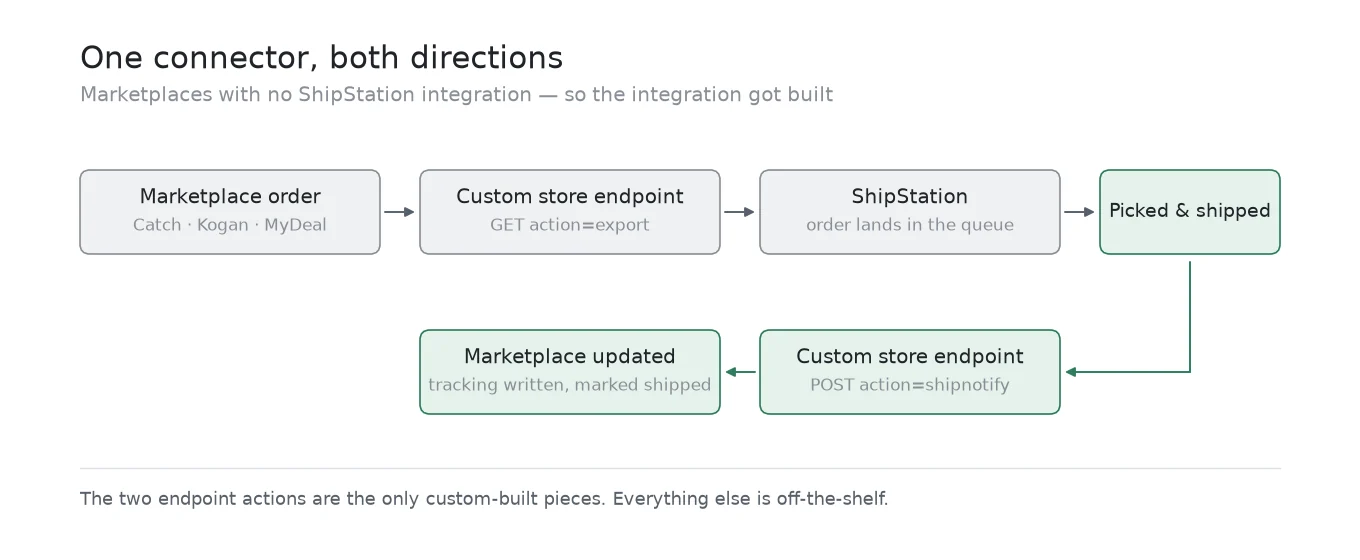
Catch, Kogan and MyDeal had no ShipStation integration. Each marketplace order took its own manual route into fulfilment, and every tracking number had to be written back by hand.

Underneath that sat the larger exposure: the storefront and marketplaces all sold from one physical stock pool, but none had a live shared availability figure. Overselling depended only on timing.

Every channel entered one fulfilment queue and received its shipment back.

Mark built one authenticated PHP connector per marketplace using ShipStation's custom-store contract. The export action returns open orders as ShipStation-formatted XML; the ship-notify action writes carrier and tracking data back and marks the marketplace order shipped.

SkuVault became the single stock master and pushed live quantities to Catch and Kogan, so a sale on one channel immediately changed availability on the others. He also generated Amazon bulk listings from product data and images.

The 2026 platform around the integrations

  • MedusaJS storefront in Docker behind Caddy
  • Beta and production hosts on DigitalOcean
  • GitHub repository secrets injected during deployment
  • The same build promoted between environments without server-local drift

The integration layer connects order intake, fulfilment, stock and the new storefront.

Engineering note

The custom code stayed small at the boundary: translate marketplace orders into ShipStation's contract, then translate shipment events back. Keeping the connector narrow is why the retailer could replace the storefront without replacing the integration spine.

Mark Philippe Mirasol Project partner · the build

The retailer replatformed around the connectors instead of replacing them.

Marketplace orders now arrive in one ShipStation queue, and tracking returns to each channel without manual re-entry.

The real-time stock push closed the obvious overselling window on the shared pool. Six years after the first connector, the ShipStation, SkuVault and storefront integrations remained the layer being wired into the next platform.

No unsupported revenue or conversion figure is claimed. The proof is operational continuity across three contracts and 951 hours and thirty minutes of tracked work.

PHP ShipStation SkuVault BigCommerce MedusaJS Docker Caddy DigitalOcean
Role
Marketplace integrations & replatforming
Partner
Mark Philippe Mirasol
Model
Long-term engineering partnership
Status
Production integrations
Project partner Mark Philippe Mirasol

Connecting e-commerce operations? See embedded engineering, business-process automation, or the software ROI calculator.

Next / Your build

Taking on new builds

Have something in mind?

Tell us what you're making. We reply within one business day, and you get a fixed price and a date in writing before any code.