

Case Study SearchAtlas

A static SEO toolset, re-architected into a 13-agent workforce.

SearchAtlas was a mature SEO platform full of dashboards that waited for a human to drive them. We rebuilt the core so Atlas Brain reads a goal, splits it into tasks, and hands them to a fleet of 13 specialized agents. OTTO does not stop at advice. It applies the fix you approve.

Client
SearchAtlas
Sector
SEO · Multi-agent AI
Engagement
Agentic system architecture & build
Stage
Live
Platform
Web · WordPress
The SearchAtlas product launch frame showing Atlas Brain and the OTTO agent driving an autonomous SEO workflow
Atlas Brain plans the work and the agent fleet carries it out, with OTTO applying approved fixes.
By the numbers
13Specialized agents
−60%Projected cost, tiered routing
80%Routine SEO tasks automated
−40%Task drift

SEO tools hand you a to-do list, then leave you to do it.

Traditional SEO platforms surface recommendations and stop. Someone still has to open each report, edit the meta tags, rewrite the schema, and repeat it across every client site.

That work is slow. It spreads across a dozen separate tools, and it falls apart the moment an agency tries to run it at scale. SearchAtlas already had the dashboards, the audits, and the content systems. They sat there waiting for a person with deep SEO knowledge to drive them.

The brief from Afaq was direct. Turn the toolset into a workforce that executes. Keep the audits and the content engine, but put an agent in front of them that can plan a goal and finish it.

Atlas Brain plans the goal and hands the work to 13 agents.

Afaq architected and built the agentic system. Atlas Brain is the master orchestrator. It decomposes a high-level goal into sub-tasks and delegates each one to the agent best suited to it, from OTTO to Content Genius to Site Explorer. An onboarding agent sets up a user's first projects on its own.

What that meant in practice

  • An event-driven core over RabbitMQ, so agents plan, call tools, and stream updates back without blocking the app
  • Existing SEO microservices exposed as callable Skills through the Model Context Protocol, so new tools land in hours
  • Memory that survives a 13-agent hand-off, with composite-key persistence ({session_id}:{agent_namespace}) on a database-backed state layer and atomic rollbacks that undo only a failed run
  • Tiered model routing that sends light tasks to fast models and saves frontier models for deep analysis

Getting hand-offs and session memory to hold under load took three agent SDKs. The team started on LangGraph, moved to the Claude Agent SDK, and settled on the OpenAI Agent SDK routed through OpenRouter, so memory and the live plan persist across auto-scaling pods.

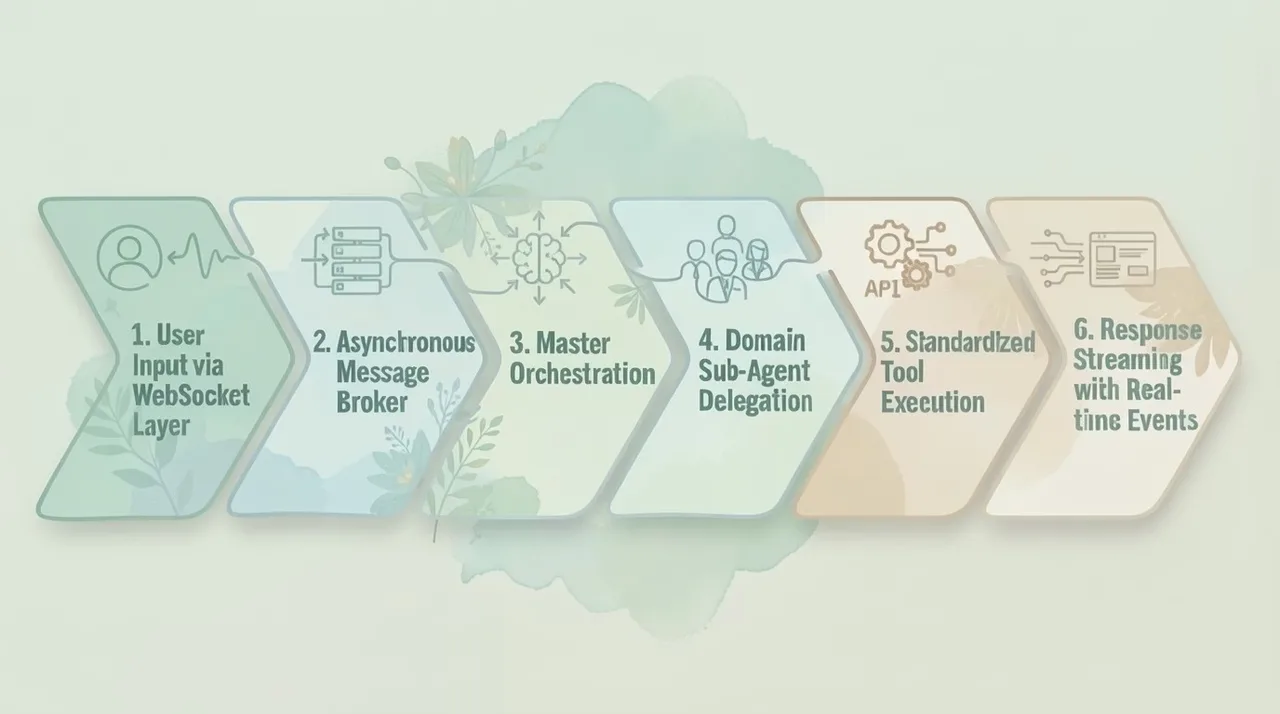
The SearchAtlas agent request flow: user input over a WebSocket layer, a RabbitMQ message broker, Atlas Brain orchestration, sub-agent delegation, tool execution, and streamed responses
Request flow

From a typed goal to a streamed result, without blocking.

A request enters over a WebSocket layer and lands on the RabbitMQ broker. Atlas Brain plans it, delegates to a sub-agent, and that agent calls its tools. Updates stream back to you as the work runs, so a long audit never freezes the page.

Event-driven over RabbitMQ · streamed updates
See it work

Walkthrough: OTTO and the agent fleet auditing and fixing a site

The SearchAtlas multi-agent architecture diagram showing Atlas Brain orchestrating a fleet of 13 specialized SEO agents including OTTO, Content Genius and Site Explorer
Architecture

One conversation, 13 experts, separate memory.

Atlas Brain sits at the top of a hierarchical multi-agent system. Each agent keeps its own private domain memory through composite-key persistence while sharing one global session. Constraining each agent to a small, well-defined toolset cut task drift by 40%.

−40% task drift · 13 specialized agents
The hardest part

Keeping memory correct across a 13-agent hand-off while pods auto-scaled was the real fight. We moved off in-memory context to a SQLAlchemy-backed state layer, keyed every session by agent namespace, and built atomic rollbacks that undo only the messages from a failed run, so a recycled container picks up exactly where it left off.

Ego Eimi Engineering note · the build

Live, running thousands of sessions, doing the work itself.

The agentic system is live and handles thousands of concurrent sessions across isolated, secure containers. 80% of routine SEO tasks, audits and schema generation among them, now finish without a single manual click.

Tiered routing sends greetings and lookups to fast models and reserves frontier models for orchestration and deep analysis. That cut projected operating cost by more than 60% and dropped latency on the simple tasks. SearchAtlas carries a 4.8 rating from 81 reviews on Capterra, and its index spans 100 trillion backlinks, 500 million domains, and 5 billion keywords.

Python OpenAI Agent SDK OpenRouter RabbitMQ MCP SQLAlchemy
Our role
Agentic system architecture & build
Team
Lead + specialists
Model
Platform build
Status
Live, evolving
Project partner Afaq Jamshad

Want a build like this? Start with a software audit, see how we build, or read the guide to building software without a tech team.

Next / Your build

Taking on new builds

Have something in mind?

Tell us what you're making. We reply within a day with a fixed price and a date.