

Outgrew no-code? The alternative is a build you own.
The alternative to no-code, once you outgrow it, is a custom build you own, migrating the workflow that hit the wall first. No-code is the right start for many founders. The wall comes later: a feature the platform will not allow, pages that crawl as data grows, fees that climb past the value, or a system that lives in someone else's account. The cheapest way to know if you are there is a short audit.
01 / The short answer
No-code was not a mistake. Outgrowing it is what success looks like.
You picked no-code because it let you prove the thing without hiring a team or learning to code. That was the right call. The wall you are hitting now is the platform doing exactly what it was built to do, which is keep everything inside a fixed set of rules. Those rules are what made it fast at the start. They are also what stop you once the product is real.
The alternative is a custom build in code you own, where the ceiling, the cost curve, the security posture, and the roadmap answer to you. You rarely have to leave all at once. You move the part that hit the wall first and keep the rest on no-code until moving it pays for itself.
02 / Where no-code starts to fight you
No-code now versus a build you own.
The same six pressures push founders off the platform. Here is how each option holds up once the product is the business.
| Staying on no-code | Custom build you own | |
|---|---|---|
| Feature ceiling | A needed feature is simply not possible. You wait for the vendor, bolt on a fragile workaround, or drop the feature. The platform decides what your product can do. | No hard ceiling. If it can be built, it can be built for you. The product roadmap is yours, not a list of what the platform happens to support. |
| Performance at scale | Pages and workflows slow as data grows, and there is no real fix because you cannot touch how it runs underneath. | Architecture is chosen for your load. It scales with the business because you control the database, the queries, and the infrastructure. |
| Fees at scale | Per-seat and per-run pricing climbs with success. You pay the tax for as long as you run on the platform, and it grows when you grow. | Higher to build once, then it flattens to hosting and changes you choose. Growth does not come with a bigger platform bill attached. |
| Ownership and lock-in | You own your data, rarely the system. The logic lives in the vendor's account and usually cannot be exported as something you can run yourself. | You own the code, repo, infrastructure, docs, prompts, evals, and deployment from the first line. No platform you cannot export, no retainer you cannot leave. |
| Security and compliance | You inherit the platform's security model and its breaches, and you cannot audit code you cannot see. Fine for low-risk tools, a real limit for sensitive data. | Building to a recognized standard is the default, and the system can be made audit-ready against a framework. We make you audit-ready, never breach-proof. |
| When to migrate | Right time is when the platform blocks a must-have feature, fees outrun value, or you need a posture it cannot give. Waiting makes the move harder, not easier. | Rarely the thing you migrate off, because you own it. The only risk is building more than you need before the workflow is proven. |
Not sure which row is the one biting you? A software audit reads it in one or two weeks. Start a conversation or see the full custom vs no-code comparison.
03 / Stay or move
Be honest about which one you are.
Plenty of founders should stay on no-code. The wall is real for some and not yet for others. Here is the honest split.
-
01
Stay on no-code if the platform still does what you need.
- The workflow is simple and stable, and the platform has not said no to anything that matters.
- Performance is fine at your current data size and you are not feeling it slow down.
- The fees are reasonable next to the value, and you are not at a scale where they bite.
- The data is not sensitive, and you do not yet need to be audit-ready against a framework.
-
02
Move to a custom build if you have hit the wall and it will not move.
- The platform blocks a feature the business needs, and the workaround is worse than the problem.
- It slows down as you grow, and you have run out of ways to fix what you cannot see under the hood.
- The bill climbs faster than the value, and you would pay that money for years to come.
- You handle sensitive data, or you need to own the system instead of renting it inside someone else's account.
The danger is waiting too long to move.
Migrating off no-code is far easier before the platform breaks than after. The right time is when it starts saying no to things the business needs. Waiting until it is already straining under your real customers, your real data, and a year of logic means untangling it all under pressure. Moving early means the new system can run alongside the old one and customers never feel the switch. Moving late means doing it live, on fire.
04 / What ownership buys you on the other side
When you migrate to a custom build, you own everything from the first line of code.
That is the line between a system and a subscription. You own the code, the infrastructure, the repo, the docs, the prompts, the evals, and the deployment. There is no platform you cannot export and no retainer you cannot leave. We design, build, and run it end to end, and either keep improving it in production or hand it over clean. You own it either way.
What a build you own can carry
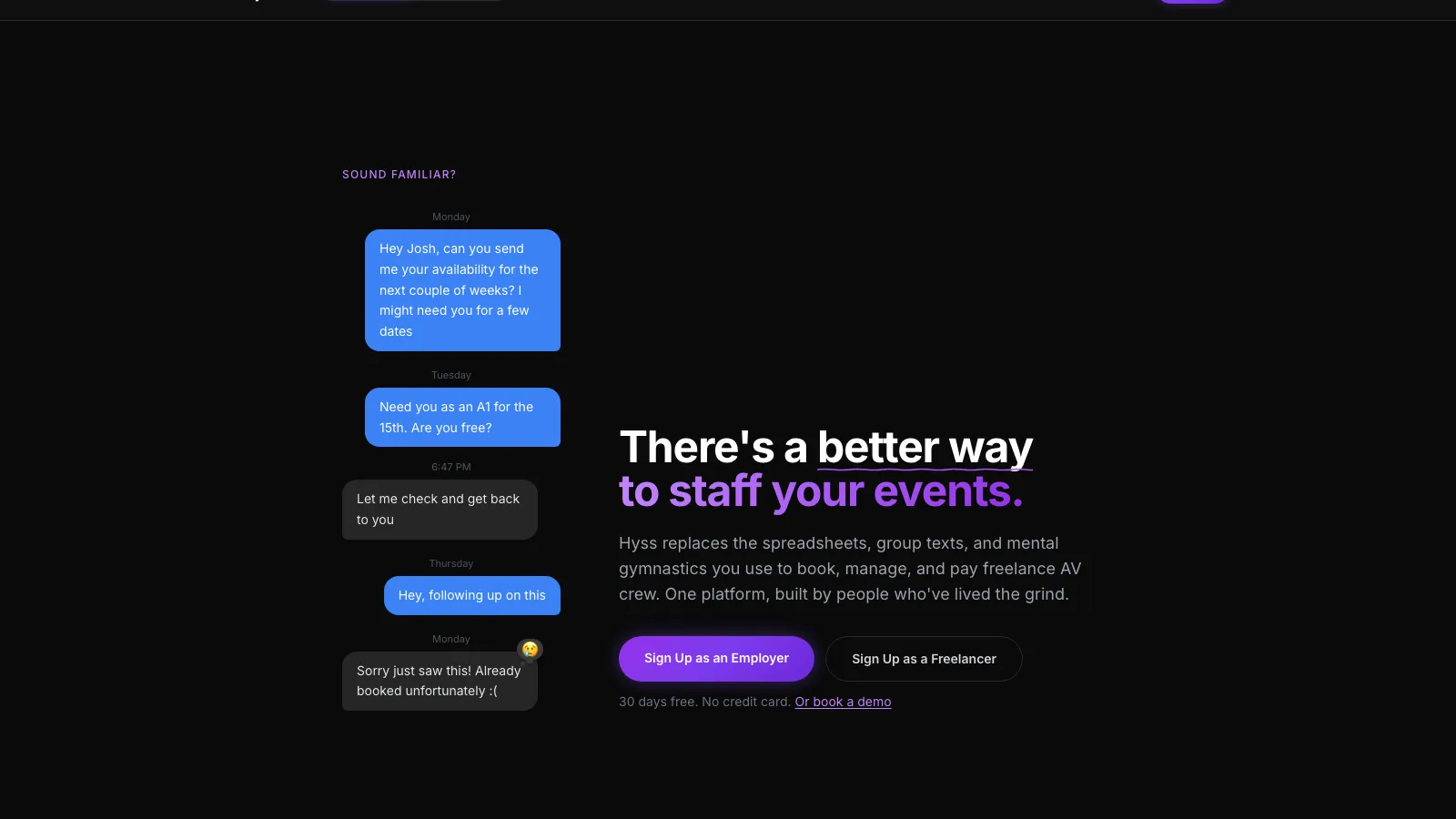
- HYSS runs an AV and live-events company's whole crew operation: staffing a show, catching conflicts before they land, and paying everyone across employers. No configuration tool was going to carry that.
- Shoperator AI became the engine behind 534K+ Shopify ads across 576 stores.
- AI Employee cut administrative hours by about 70% across pilot customers, with AI behavior built to hold under real use.
See the rest across fintech, healthcare, e-commerce, and operations in the case studies.
05 / The cheapest way to decide
Get a salvage-or-rebuild call before you commit.
You do not have to guess whether you have outgrown the platform. The audit reads what you have and tells you what to migrate, what to keep, and what it costs.
-
01
Week 0–1
We read what you built on no-code
We map the system, the lock-in, the performance ceiling, the security exposure, and where the AI sits. We find the exact workflow that hit the wall.
-
02
Week 1–2
We make the salvage-or-rebuild call
A risk and security map, plus what to migrate now, what to leave on no-code, and scope with signed acceptance criteria and quantified ROI. Sometimes the answer is to stay, and we will say so.
-
03
Decision
You choose with the numbers in hand
If you build, the audit fee is credited in full. For pre-screened fits, the value guarantee applies: we find at least 10x the fee in value you agree is real, or it is free.
Start with the software audit if you already have something on a platform, or see how we work. Start a conversation and we reply within one business day, and you get a fixed price and a date in writing before any code.
06 / Common questions
What is the best alternative to no-code once I outgrow it?
A custom build you own. Once the platform stops doing what the business needs, the move is to rebuild the parts that matter in code that lives in your repo, runs on your infrastructure, and answers only to you. You do not have to throw everything out at once. Often you migrate the workflow that hit the wall first and leave the rest on no-code until it is worth moving. The honest first step is a software audit that gives you a salvage-or-rebuild call before you commit a dollar to building.
How do I know I have outgrown Bubble, Webflow, or another no-code tool?
You feel it as a pattern rather than a single bug. The platform says no to a feature the business needs. Pages or workflows slow down as data grows and there is no real fix. The monthly bill climbs faster than the value you get from it. You handle data that needs a security or compliance posture the platform cannot give you. Or you realize the system that runs your business lives in someone else's account and you cannot export it. Any one of these can be lived with. Two or three together is the wall.
Do I have to rebuild everything to move off no-code?
No, and trying to is usually the wrong move. The cheaper path is to migrate the part that hit the wall first, the workflow that is slow, blocked, or carrying real risk, and leave the stable, simple parts on no-code until moving them earns its keep. We map that split in the audit so you spend the build budget where it buys you something instead of on recreating a contact form that was fine where it was.
Will I lose my data and customers when I migrate off a no-code platform?
Not if it is planned. You own your data, even when you do not own the system, so it can be exported and brought into the custom build. The risk is doing it late and under pressure, when the no-code version holds all your live customers and a year of logic. We plan the cutover so the new system runs alongside the old one, the data moves cleanly, and customers do not feel the switch. That is far easier to do before the platform is straining than after it breaks.
How much does it cost to move off no-code to a custom build?
It depends on how much you migrate, which is exactly what the audit settles. The audit is a small, fixed fee, takes two to eight weeks, and is credited in full toward a build. A focused build to replace what you outgrew is typically a fixed-price Forge engagement, with published ranges of $15,000 to $50,000 and up, set before any code, over four to eight weeks, with a fixed scope, price, and deadline agreed up front. You get a price and a date within one business day of telling us what hit the wall.
Last updated July 2026 · Talk with Felipe
Your build
Taking on new builds
Have something in mind?
Tell us what you're making. We reply within one business day, and you get a fixed price and a date in writing before any code.