


Case Study Healthcare · AI document intelligence

Scanned insurance documents into structured data, at scale.

A medical-billing operation drowns in scanned paper and slow manual reconciliation. We built an AI document-intelligence platform that reads documents across 150+ carriers and 1,000+ formats, scores its own confidence, and sends only the uncertain cases to a person. The same system reconciles carrier statements against AMS360, end to end.

Client
Medical Billing Automation Platform
Sector
Healthcare · AI automation
Engagement
AI automation build
Stage
Delivered
Platform
Web app · pipeline
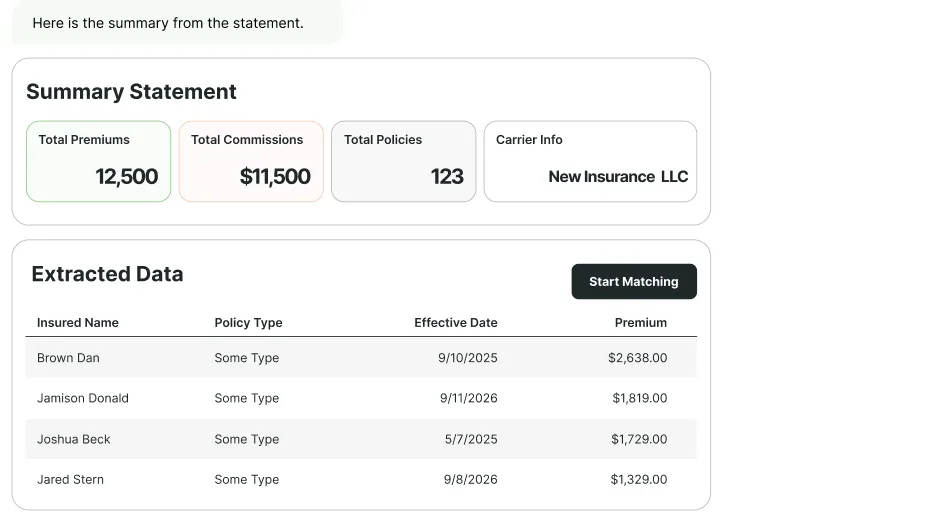
Medical Billing Automation — the platform showing structured billing fields extracted from a scanned insurance document next to a summary statement, using test data
Extracted billing data beside a summary statement, read straight off a scanned document. Test data shown.
By the numbers
150+Carriers ingested
1,000+Document formats
OCR + AIClassification
Human-in-the-loopReview on uncertain cases

Insurance back-office work runs on scanned paper and slow reconciliation.

Every policy, denial, payment and verification arrives as a scanned document. A team keys the numbers in by hand, one file at a time, then chases anything that does not match.

The volume is the problem. Documents land across 150+ carriers in 1,000+ layouts, so no single template fits. The work is repetitive, mistakes slip through, and adding more people does little for throughput.

Reconciliation makes it worse. Each carrier statement has to line up against the agency-management system, AMS360, transaction by transaction. Someone reads a PDF, finds the matching policy, and posts the result. Multiply that across a month of statements and the finance team falls behind.

One pipeline from scanned page to posted transaction.

We built the platform around a high-performance pipeline that runs in parallel. A document comes in, and image preprocessing, OCR, AI classification, data extraction and validation each take their pass across many processes at once. Every field gets a confidence score, and validation rules decide what a person needs to look at. The clean cases flow through; the uncertain ones land in front of a reviewer.

What that meant in practice

  • Ingestion across 150+ carriers and 1,000+ document formats through one OCR and document-intelligence pipeline
  • An AI classifier that sorts each scan into policy, denial, payment, verification or supporting document
  • Confidence scoring and validation rules that route only the uncertain extractions to human review
  • A policy-matching engine that reads carrier statements, validates against AMS360, and walks a user from ingestion to final posting
Medical Billing Automation — extracted policy and payment fields shown next to a summary statement, with each value tied back to where it was read on the scanned document, using test data
Extraction

The numbers, pulled off the page and ready to check.

The pipeline normalizes a scanned policy or payment into structured fields and lays them beside a summary statement. A reviewer sees what the system read, where it read it, and how sure it was, so verification takes a glance instead of a re-key. Test data is shown here.

Confidence-scored extraction · review only on doubt
The hardest part

1,000+ layouts means no template ever holds, so the win was making the system honest about its own doubt: score every field, prove where each number came from on the scan, and hand a reviewer only the cases the model could not stand behind.

Ego Eimi Engineering note · the build
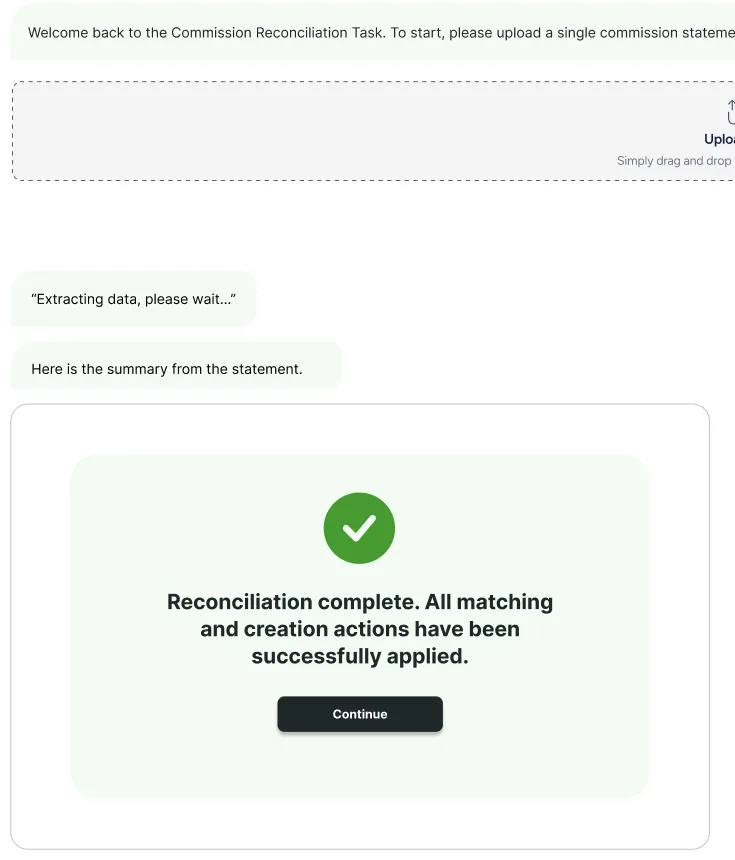
Medical Billing Automation — a completed reconciliation run with carrier-statement lines categorized as exact, partial or no match against AMS360, and resolution actions for the rest, using test data
Reconciliation

Every carrier line, matched against AMS360.

The policy-matching engine reads policy, premium and commission data off each statement, then validates it against AMS360 and labels every transaction an exact, partial or no match. The exact ones clear on their own. For the rest, the workflow walks a user through creating a policy, matching by hand, or handling the exception, then posts the result. Test data is shown here.

Exact / partial / no match · ingestion to posting

Delivered and in production, holding the repetitive work.

The platform runs in production today. It ingests scans across 150+ carriers, classifies and extracts them through the parallel pipeline, and reconciles carrier statements against AMS360 from one workflow.

People still own the judgment calls. The pipeline carries the bulk volume and routes the doubtful cases to a reviewer, so the team spends its hours on exceptions instead of re-keying. The reconciliation side closes the loop the same way, from statement ingestion through to final posting.

OCR AI classification Parallel pipeline Python AMS360 Confidence scoring
Our role
AI automation build
Team
Lead + specialists
Model
Delivered platform
Status
In production
Project partner Muhammad

Want a build like this? Start with a software audit, see how we build, or read the guide to building software without a tech team.

Next / Your build

Taking on new builds

Have something in mind?

Tell us what you're making. We reply within a day with a fixed price and a date.