

Field service and events software for companies that schedule people into jobs.
If your business coordinates crews, technicians, or event staff into jobs, the software that matters is scheduling, availability, dispatch, timesheets, and paying the people who did the work. Ego Eimi builds those systems for companies without a tech team, at a fixed price and a fixed date, and you own the code from day one. Many operators are better served by an off-the-shelf tool, and we say so when that is the honest answer.
01 / The short answer
A business that schedules people into jobs has one software problem underneath all the others: knowing who is available, getting the right person to the right place, and paying them correctly afterward.
That usually runs on a spreadsheet and a group chat, and it holds until the roster grows past what one manager can carry in their head. Then it fails in ways you can name. A crew member booked twice on the same Saturday. A job that goes out without the person who holds the certification. A subcontractor invoice nobody can match to a shift. The cost is rarely the software. It is the callback, the overtime, and the client who watched it happen.
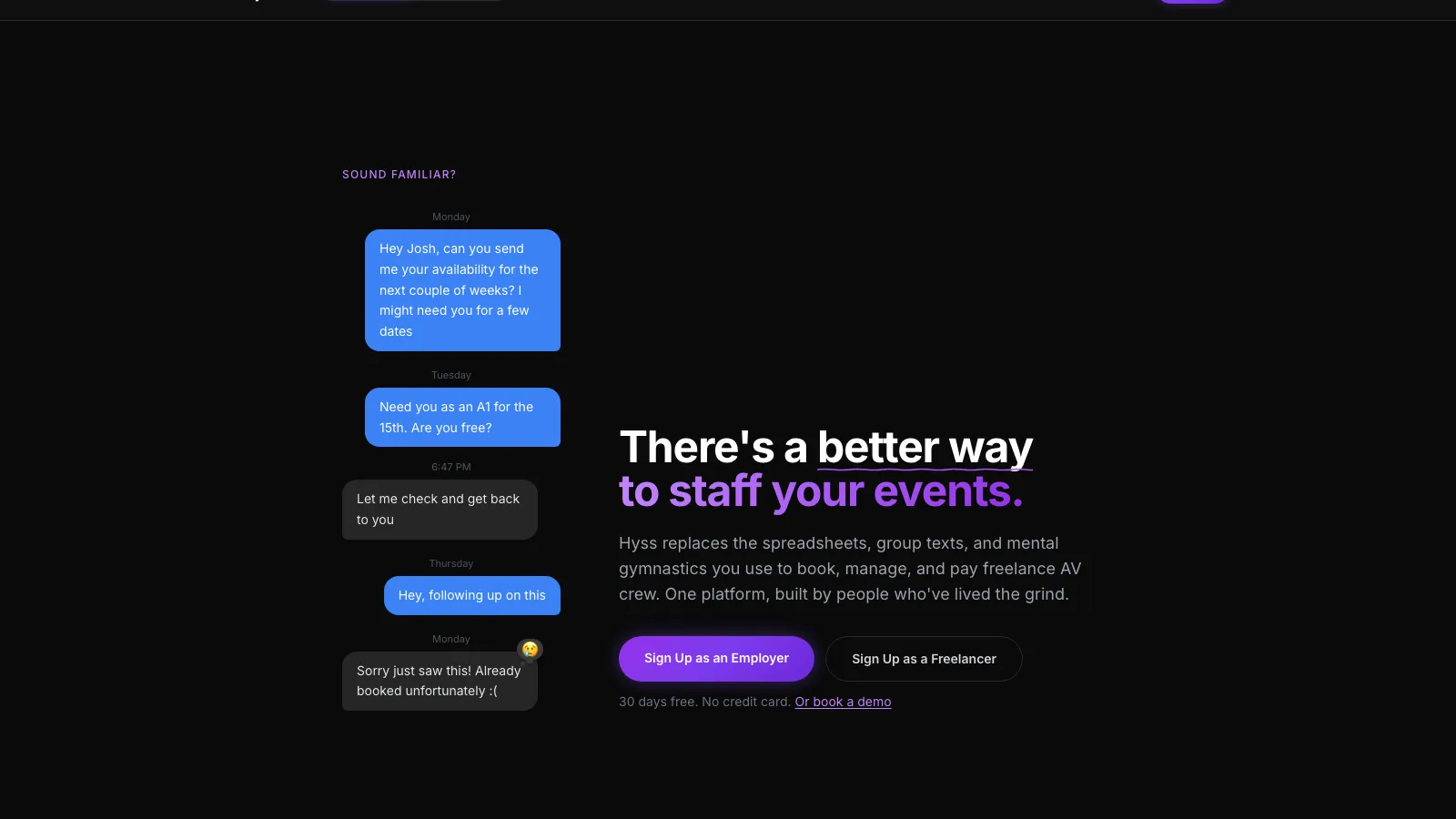
Ego Eimi builds the system that takes over when that layer stops holding. We have shipped two of them. HYSS is a crew-management platform for AV and live-events companies to book, schedule and pay freelance crew, with a conflict engine that validates every booking. Collaborate is CRM and RevOps automation for an experiential-marketing agency that reports getting about two days a week back.
This is the one industry page here that is not about a regulated market; the industries hub also covers fintech, healthcare and Bitcoin. If you are earlier than this and still working out whether to build anything at all, start with the guide to building software without a tech team.
02 / What breaks first
What breaks first when you schedule people into jobs?
The spreadsheet does not fail all at once. It fails at the edges: a double booking nobody catches until load-in, availability that lives in one manager's head, invoices reconciled by hand at the end of the month. Every one of those is a coordination gap, and every one of them costs money in front of a client.
-
01
Two people book the same person.
- Two managers work from two copies of the roster and both are certain the Saturday is covered.
- Nobody finds out until load-in, when the person who was double-booked is standing somewhere else.
-
02
The job goes out without the right person.
- Knowing who is free is easy. Knowing who is free, qualified and near enough to get there is a different question.
- Certifications, gear competencies and positions sit in someone's memory or in a folder nobody opens.
-
03
Availability lives in one manager's head.
- Availability gets collected by text message, then cross-referenced against a sheet by hand.
- When that manager is away, the schedule slows to whatever the rest of the team can reconstruct.
-
04
The paperwork chases people instead of the other way round.
- W-9s and certificates of insurance sit in inboxes while someone chases who has sent what.
- Subcontractor and freelancer invoices get matched to shifts by hand, and every client is on a different rate.
-
05
Nobody has one view of today.
- The call sheet is the closest thing to it. You build it, send it, then one detail changes and every copy in every inbox is stale at once.
- The version open on a phone at the venue is the one that matters, and it is the one most likely to be wrong.
03 / Off-the-shelf or custom
When does a custom build earn its price here?
Often it does not. Field-service and scheduling products are a mature category, and if one of them fits the way you dispatch, buying it beats building it on nearly every measure. Custom earns its price when the way you schedule is the business, and no product will bend that far.
| What you are weighing | Off-the-shelf field-service tool | A custom build |
|---|---|---|
| Time to value | Days. You can be dispatching this week, and a trial costs nothing to walk away from. | One to two weeks of audit, then four to eight weeks of build before anyone uses it. |
| Fit to how you actually schedule | Close, if your operation looks like the ones the product was designed around. You bend to the tool. | Exact, including the rules that make your operation yours. The tool bends to you. |
| Cost over time | Per seat, per month, indefinitely, and it climbs with headcount whether or not you use more of it. | Paid once to build, then hosting and upkeep. Cheaper past a certain size, more expensive below it. |
| Ownership | You rent the software, and your history sits in someone else's system on their terms. | You own the repository, the infrastructure, the documentation and the deployment from day one. |
| Switching cost | Real. Your rate cards, your job history and your integrations are all in their format. | You keep the code and the data, so another team can take it over. Not free, but possible. |
Work the decision before you spend anything: build vs buy software, or the honest case against building in when not to build custom software.
04 / What we have built in this space
Two systems, both in production.
We have shipped two systems for businesses that coordinate people into work, and both are published here with their scope and their numbers intact. Two is what we have. Neither was for a trade like plumbing or HVAC, so if that is your operation, read these as adjacent proof rather than a match.
| Client / Project | What we built | Result |
|---|---|---|
| HYSS | A crew-management platform that gives AV and live-events companies one place to staff a show, catch a conflict before it lands, and pay everyone after. We built the platform architecture and backend, with a conflict engine that validates every booking and billing that stays private across shared jobs. Delivered with project partner Zain Raza. | Live on web, iOS and Android. One model handles employees, freelancers and agency workers, and conflicts are caught at write time before they reach the database. |
| Collaborate | CRM and RevOps automation for a global experiential-marketing agency whose deal data lived in HubSpot, Scoro and Airtable and was kept in sync by hand. We built a self-healing n8n orchestration that does it for them, with AI deal scoring along the way. Delivered with project partner Abhishek Gawade. | The agency reports saving one to two hours every day, about two days a week, and the two to three people who kept the systems in agreement moved onto the creative work the agency sells. |
Want the same on your operation? Start with a Spark audit or browse all case studies. Start a conversation.
05 / How a build like this runs
-
01
1–2 wks
Spark audit
If you already run a spreadsheet system, a no-code build, or something a developer left behind, we read it and tell you what is worth keeping. If you are starting from the process, we map the way you schedule today and scope the build. Small fixed fee, credited in full to a build.
-
02
4–8 wks
Forge build
Fixed scope, fixed price, fixed deadline, with published ranges of $15,000 to $50,000 and up. Signed acceptance criteria, so done means done in writing. If a build misses those criteria, remediation is free against them for roughly six weeks.
-
03
Ongoing
Engine team
An embedded team that keeps the system running as the roster grows, the integrations change, and the rules move. You stay involved and you keep owning everything.
You own the repository, the infrastructure, the documentation and the deployment from day one. See the fixed-price build, the embedded engineering team, or what each engagement costs.
06 / What it has to talk to
Where does a scheduling system touch the rest of your stack?
Almost none of these systems stand alone. A schedule is only useful if the hours reach payroll, the finished job becomes an invoice, and the calendar your crew already lives in stays right. That surface is where an estimate moves, so we map it in the audit before anyone quotes you a number.
- + Accounting and invoicing, so a completed job becomes a bill without anyone retyping it
- + Payroll and timesheets, including the difference between an employee, a subcontractor and a freelancer on the same job
- + The calendar your crew already uses, because a schedule they cannot see on their phone is not a schedule
- + Payment to the people who did the work, with each client's rates and each employer's records kept separate
- + The documents that have to be current before someone can be assigned, from certifications to insurance
- + Whatever you already run and are not replacing, because the point is to remove the retyping without starting over
On the HYSS crew platform that surface included Google Calendar, QuickBooks and Stripe. Scoping it early is the whole argument in how to scope software before hiring.
07 / When the person who built it leaves
What happens when the person who built your spreadsheet system leaves?
In an NAIC survey cited by the Insurance Information Institute, 71% of small firms said they depend heavily on one or two key people. In a scheduling business that is usually whoever built the spreadsheet. When they leave, the business keeps running and the system stops changing, because nobody left knows how it works.
- + Written documentation of how the schedule works, including the rules nobody ever wrote down
- + The repository, the hosting and the accounts in the company's name rather than a personal one
- + A second person who can change the system without breaking payroll
- + Tests around the rules that cost real money when they are wrong, like pay rates and who can see what
- + A system any competent engineer can pick up later, which is also what a buyer's diligence will ask for
Read what key-person risk means in practice, or see how software rescue takes over a system whose builder is already gone.
08 / Common questions
Do you build scheduling and dispatch software for field service businesses?
We build custom scheduling, dispatch and crew systems for companies that coordinate people into jobs. What we have shipped in this space is two systems. HYSS is a crew-management platform for AV and live-events companies, where we built the platform architecture and backend, delivered with project partner Zain Raza. Collaborate is CRM and RevOps automation for a global experiential-marketing agency, delivered with project partner Abhishek Gawade. We have not shipped a system for plumbing, HVAC, electrical, landscaping or the other trades, and we are not going to imply we have. If your operation is close to what we have built, the audit is where we find out.
Should we just buy an off-the-shelf field service tool instead?
Often, yes. If a proven product already does eighty percent of the job, buy the product and spend what you saved somewhere else. Two rules we hold to: if a product fits the way you dispatch, use it, and if your process is still changing every few weeks, wait until it settles, because software freezes a process in code. Custom earns its price when the way you schedule is the business, no product bends that far, and the operation is stable enough to be worth owning. We work the same decision through in build vs buy software and in when not to build custom software.
What does a system like this cost?
A software audit runs about $5,000 to $15,000 and is credited in full to your build. A fixed-price build usually runs about $15,000 to $50,000 and up, set in writing before any code. An embedded engineering team runs about $14,000 to $48,000 a month. Your exact number comes out of the audit, because on this kind of system the integration work is what moves it. The published ranges and what sits behind them are on the pricing page.
Can it work with the accounting, payroll and calendar we already use?
That is usually most of the work. A schedule is only useful if the hours reach payroll, a finished job becomes an invoice, and the calendar your crew already lives in stays right. On the HYSS crew platform that surface included Google Calendar, QuickBooks and Stripe alongside the platform itself. We map every system you are keeping during the audit, before anyone gives you a number, because the integration surface is where an estimate moves.
Our schedule lives in a spreadsheet one person built. Where do we start?
Start with the audit before you commit to a build. In one to two weeks we read what you have, write down how the schedule works today, and give you a salvage-or-rebuild call in writing with a number attached. Sometimes the honest answer is that the spreadsheet is fine and the gap is one integration. If the person who built it is already gone, that is what software rescue is for.
Do we own what you build?
Yes, from the first line. You own the repository, the infrastructure, the documentation, the prompts, the evals and the deployment from day one. There is no vendor lock-in and no retainer you cannot leave. If you bring in your own team later, or sell the business, the system is documented and tested so someone else can take it over cleanly.
Last updated July 2026 · Talk with Felipe
Your build
Taking on new builds
Have something in mind?
Tell us what you're making. We reply within one business day, and you get a fixed price and a date in writing before any code.